

A3 vs A4 Printers: Which Is Right for Your Company Documents?
Every office depends on reliable printing to keep daily operations running smoothly. From contracts and invoices to presentations and marketing materials, printers remain a critical part of business communication. When companies plan to invest in a new office printer, one of the most common questions is whether an A3 printer or an A4 printer is the better option.
For many businesses in Abu Dhabi and across the UAE, choosing the right printer is an important decision because it directly affects daily productivity and document management. Understanding the differences between these two printer types can help organizations select a solution that matches their document requirements, printing volume, and long-term growth.
This guide explains the practical differences between A3 vs A4 printers, their advantages, and how businesses can determine which option best fits their office workflow.
Understanding A3 and A4 Paper Sizes
Before comparing printers, it is useful to understand the paper sizes they support.
A4 paper measures 210 × 297 mm and is the most widely used document size in offices. Most everyday business documents—such as reports, letters, invoices, and internal paperwork—are printed in A4 format.
A3 paper measures 297 × 420 mm, which is twice the size of A4. This larger format is useful for documents that require more space, such as diagrams, technical drawings, charts, posters, and marketing layouts.
An A4 printer is designed primarily for standard office documents, while an A3 printer can print both A3 and A4 sizes. This additional flexibility makes A3 printers suitable for businesses that occasionally require larger print formats.
Why Printer Selection Matters for Businesses
Many organizations focus on printer price when making a purchase decision. However, the right printer can have a significant impact on productivity, document quality, and long-term operational costs.
A well-chosen printer can help businesses:
Improve workflow efficiency
Reduce printing delays
Support professional document presentation
Handle growing document demands
For companies that produce large documents or visual materials, choosing the wrong printer can lead to frequent outsourcing of prints, which increases operational expenses.
Key Differences Between A3 and A4 Printers
Print Size Capability
The most noticeable difference between A3 and A4 printers is the maximum paper size they support.
A4 printers are limited to standard document sizes such as A4, A5, and envelopes. These printers work well for everyday office tasks like printing contracts, invoices, employee records, and reports.
A3 printers offer greater flexibility because they can handle both A3 and A4 paper sizes. This means businesses can print larger documents when necessary without needing an additional device.
For teams that regularly create spreadsheets, charts, or design materials, this capability can be very useful.
Office Space and Printer Design
Printer size is another important consideration, especially for offices with limited workspace.
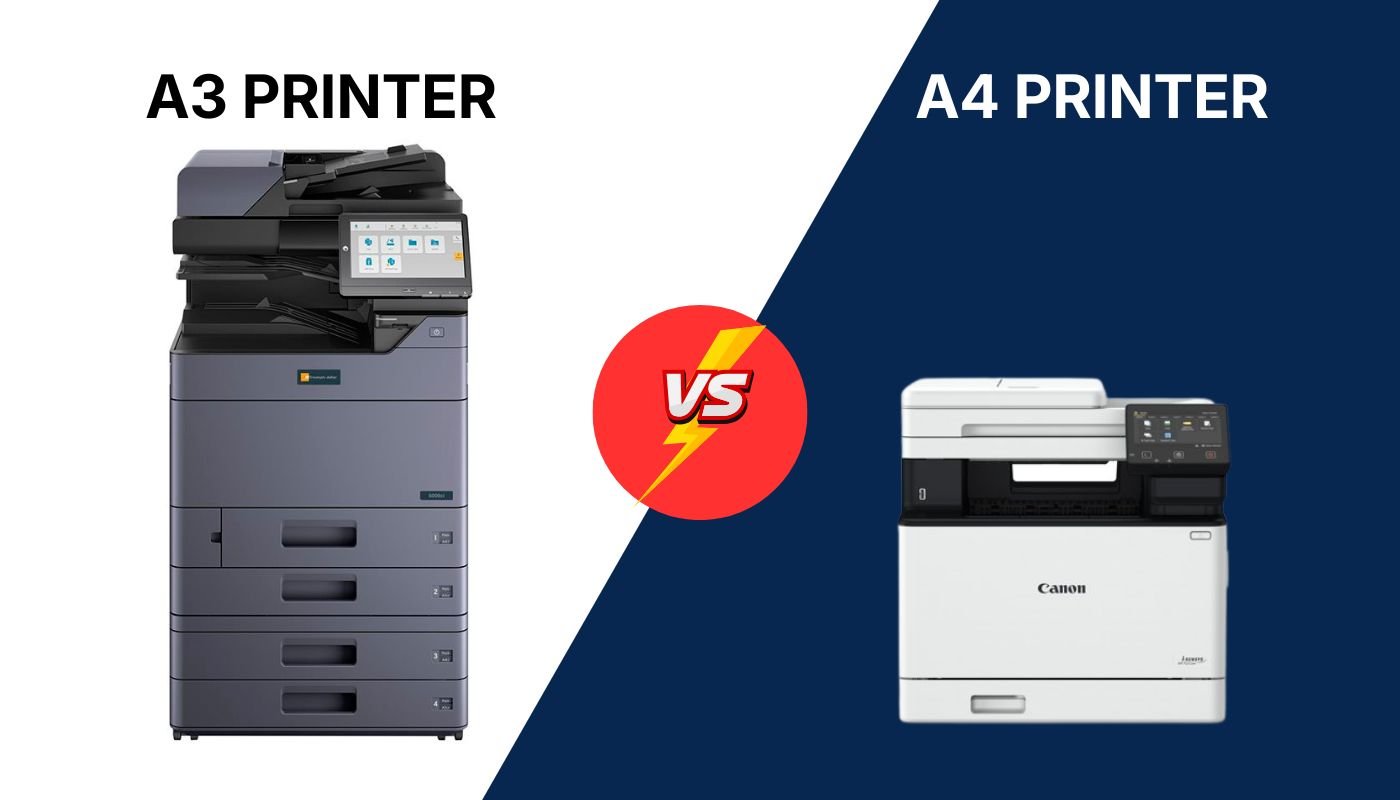
A4 printers are generally compact and easy to place on desks or small office cabinets. Their smaller footprint makes them suitable for small teams, startups, or departments with limited printing needs.
A3 printers are typically larger multifunction devices. They are often designed as central office machines that multiple employees can use. Because of their size, they are usually placed in common office areas rather than individual desks.
Printing Volume and Performance
Another important difference between A3 and A4 printers is their ability to handle high workloads.
Many A3 printers are built for larger organizations and offer higher monthly duty cycles. They are designed to support heavy printing environments without slowing down or overheating.
A4 printers, on the other hand, are generally built for moderate daily printing. They perform efficiently in smaller offices where document volume is manageable.
For businesses expecting rapid growth or increased document demand, investing in a higher-capacity printer can help avoid frequent upgrades.
Cost and Operational Expenses
Budget is always a major factor when purchasing office equipment.
A4 printers are typically more affordable to purchase and maintain. They consume less power and use smaller toner cartridges, which helps keep operating costs lower.
A3 printers often require a higher initial investment because of their larger components and advanced features. However, they can deliver better long-term value for organizations that frequently produce large documents or require multifunction capabilities.
Some companies choose printer leasing or managed print services to spread out costs and ensure professional maintenance.
Advanced Features and Capabilities
Modern office printers have evolved far beyond basic printing functions.
Most A4 printers now include features such as wireless printing, scanning, and automatic double-sided printing. These features are sufficient for many everyday office tasks.
A3 multifunction printers often include more advanced capabilities, including:
High-speed document scanning
Cloud connectivity
Mobile printing support
Large paper capacity
Secure printing options
These features can improve workflow efficiency and document security, particularly in offices where multiple departments share the same printer.
Industries That Often Use A3 Printers
Although A4 printers are sufficient for many organizations, certain industries benefit greatly from A3 printing.
Construction and Engineering
Technical drawings, floor plans, and site layouts require larger formats to maintain clarity. A3 printing allows teams to review detailed plans without shrinking them onto smaller pages.
Marketing and Creative Agencies
Design teams frequently work with brochures, layouts, and promotional visuals. A3 printers allow them to review designs more accurately before final production.
Education and Training
Training materials, charts, and classroom visuals are easier to understand when printed on larger pages.
Healthcare and Medical Facilities
Hospitals and clinics often print charts, reports, and informational displays where larger formats can improve readability.
In these sectors, an A3 printer can significantly enhance document usability.
When an A4 Printer Is the Practical Choice
For many organizations, an A4 printer remains the most practical solution.
Companies that primarily print text documents rarely need larger paper sizes. In these cases, an A4 printer provides all the necessary functionality without taking up extra office space or increasing costs.
A4 printers are especially suitable for:
Small and medium-sized businesses
Administrative departments
Customer service teams
Offices with limited space
Organizations focused on routine document printing
Their simplicity, affordability, and efficiency make them a popular choice for everyday office operations.
Choosing the Right Printer for Your Office
Selecting the right printer should always start with evaluating how your team uses documents.
Some key questions businesses should consider include:
Do employees frequently print large diagrams or presentations?
How many pages does the office print daily?
Is office space limited?
Will printing needs grow in the future?
If most documents are standard letters or reports, an A4 printer is usually sufficient. If teams often need larger documents or visual materials, an A3 printer may provide better flexibility.
Companies in growing business hubs such as Abu Dhabi often choose scalable printing solutions so their equipment can support future expansion.
The Future of Office Printing
Printing technology continues to evolve as businesses adopt smarter workflows. Modern office printers now integrate with digital systems and cloud platforms, allowing employees to print securely from multiple devices.
Energy-efficient printers and document management systems are also becoming more popular as companies aim to reduce operational costs and environmental impact.
These advancements are helping organizations improve document handling while maintaining high productivity.
Conclusion
Choosing between A3 and A4 printers ultimately depends on your company’s document requirements and workflow.
A4 printers remain the best option for offices that primarily print everyday documents such as invoices, contracts, and reports. They are compact, cost-effective, and easy to maintain.
A3 printers provide greater versatility by supporting both A3 and A4 formats, making them ideal for businesses that regularly handle diagrams, charts, design materials, or larger documents.
For businesses looking for reliable printing solutions, professional guidance can make the decision much easier. Green Wave supports companies in choosing the right printer technology based on their operational needs, helping improve efficiency and reduce printing costs. With dedicated services across Abu Dhabi, Dubai and all over UAE, Green Wave helps businesses implement practical and scalable document printing solutions for modern workplaces.