

LaserJet vs. Inkjet for High-Volume Office Printing: Total Cost of Ownership
Choosing the right printer for your office is about more than the initial purchase price. If your business prints hundreds or thousands of pages every month, the cost of toner or ink, maintenance, replacement parts, and downtime can significantly affect your printing budget.
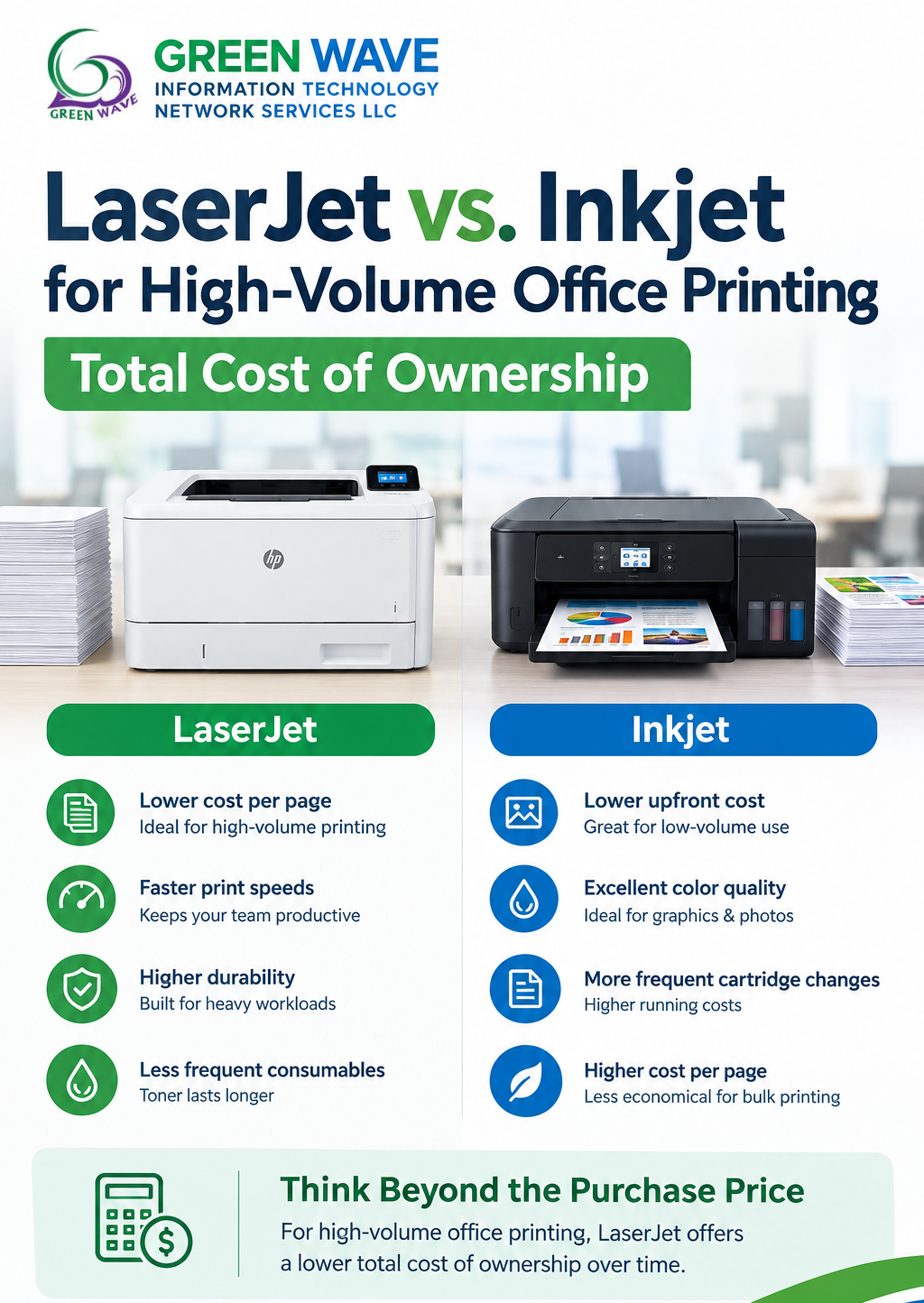
When comparing LaserJet vs. inkjet for high-volume office printing, businesses should consider the total cost of ownership (TCO) rather than focusing only on the printer’s purchase price.
At Green Wave Information Technology Network Services LLC, we help businesses in Abu Dhabi and across the UAE find suitable printing solutions based on their workload, budget, and business requirements.
In this guide, we compare laser and inkjet printers to help you determine which technology offers better long-term value for your office.
What Is the Difference Between LaserJet and Inkjet Printers?
LaserJet Printers
Laser printers use toner powder and a laser-based imaging process to produce text and images on paper. They are commonly used in offices that require frequent document printing, professional text quality, and consistent performance.
Key advantages of laser printers:
- Fast printing for everyday business documents.
- Sharp text for invoices, reports, contracts, and business correspondence.
- High-capacity toner options for many business models.
- Reliable performance for regular printing workloads.
- Colour and monochrome options, including multifunction printers.
Laser printers are particularly suitable for offices, schools, corporate environments, and businesses with high monthly print volumes.
Inkjet Printers
Inkjet printers create images and text by spraying tiny droplets of liquid ink onto paper. They are available in standard cartridge-based models and refillable ink-tank models.
Key advantages of inkjet printers:
- Excellent colour and photo printing capabilities.
- Affordable entry-level models.
- Refillable ink-tank options that can reduce ink costs per page.
- Compact designs suitable for smaller workspaces.
- Flexible printing for documents, graphics, and marketing materials.
Inkjet printers can be a good choice for small offices, creative teams, and businesses that prioritise colour images or have moderate printing requirements.
LaserJet vs. Inkjet: Quick Comparison
Feature | LaserJet printer | Inkjet printer |
Printing technology | Toner powder | Liquid ink |
Initial purchase cost | Varies; often higher for business models | Often lower for basic models |
Cost per page | Often competitive for high-volume text | Varies by cartridge or ink-tank system |
Printing speed | Generally faster for office documents | Varies by model and print mode |
Text quality | Excellent for business documents | Good to excellent, depending on model |
Photo printing | Good on suitable colour models | Often better for photo-focused printing |
Maintenance | Toner and imaging components may need replacement | Printheads, cartridges, and ink systems need maintenance |
Best use | Frequent office document printing | Photos, colour graphics, and selected office workloads |
Actual performance and operating costs depend on the specific printer model, consumables, paper type, and usage patterns.
Understanding Total Cost of Ownership (TCO)
Total cost of ownership is the estimated cost of buying and operating a printer throughout its useful life.
A printer with a low purchase price may become expensive if it requires frequent cartridge replacements. Similarly, a higher-priced business printer may deliver better value if it handles large workloads efficiently.
To compare printers accurately, consider these five cost factors.
- Initial Purchase Price
The purchase price is the first expense to consider. Basic inkjet printers can be affordable for businesses with limited printing requirements. Business-class laser printers may require a larger initial investment, especially when they include scanning, copying, duplex printing, and network connectivity.
However, comparing purchase prices alone does not show which printer will be cheaper over three to five years.
- Toner and Ink Costs
Consumables are among the most important factors in high-volume printing.
Laser printers use toner cartridges, while inkjet printers use ink cartridges or refillable ink tanks. The cost of replacement supplies and their rated page yields can vary considerably.
Before purchasing a printer, check:
- The price of genuine replacement toner or ink.
- The rated page yield of each consumable.
- The expected monthly print volume.
- Whether high-capacity consumables are available.
- The availability of compatible supplies and replacement parts.
Tip: Compare the cost per page instead of comparing cartridge prices alone.
Cost per page can be estimated as:
Cost per page = Consumable cost ÷ Expected pages printed
For a more complete comparison, account for colour coverage, replacement components, and other operating expenses.
- Maintenance and Repairs
Maintenance costs can affect the long-term value of any office printer.
Laser printers may require replacement of components such as drums, fuser units, rollers, and transfer components, depending on the model. Inkjet printers may require printhead cleaning, cartridge replacement, or servicing related to ink delivery systems.
The best option depends on the printer’s design, workload, operating environment, and service requirements.
For offices that rely on daily printing, scheduled servicing and access to qualified technicians can help reduce unexpected downtime.
- Printing Speed and Productivity
Printing speed matters when several employees share a printer or when large documents must be produced quickly.
Many business laser printers are designed for high-volume document processing. However, actual speed varies by model, paper size, colour mode, document complexity, and print settings.
When evaluating a printer, consider:
- Pages per minute (PPM).
- First-page-out time.
- Automatic duplex printing.
- Paper capacity and optional trays.
- Monthly duty cycle and recommended monthly volume.
Choosing a printer that matches your workload can improve office productivity and reduce waiting time.
- Downtime and Business Continuity
Printer downtime can interrupt invoicing, customer documentation, reporting, and other daily operations.
For high-volume offices, it is important to consider service response times, spare-part availability, warranty coverage, and access to replacement equipment when necessary.
Businesses with demanding workloads may benefit from an annual maintenance contract (AMC) or a printer rental agreement that includes clearly defined service terms.
Which Printer Has the Lowest Cost Per Page?
There is no universal winner between laser and inkjet printers. The lowest cost per page depends on the printer model, consumables, print coverage, and maintenance requirements.
For example, a business laser printer with high-yield toner may offer competitive costs for frequent text printing. A refillable ink-tank printer may also deliver a low cost per page for suitable workloads.
To make a fair comparison, calculate the expected monthly and annual printing costs for the exact models you are considering.
Example: Comparing Printing Costs
Suppose an office prints 10,000 pages per month.
Cost factor | Printer A | Printer B |
Purchase price | AED 2,500 | AED 4,500 |
Estimated consumable cost per page | AED 0.08 | AED 0.05 |
Monthly print volume | 10,000 pages | 10,000 pages |
Monthly consumable cost | AED 800 | AED 500 |
Annual consumable cost | AED 9,600 | AED 6,000 |
Illustrative figures only, not current market prices or quotes for specific printer models. Maintenance, paper, electricity, downtime, and replacement components are excluded.
In this example, Printer B costs AED 2,000 more initially but saves AED 3,600 per year in consumables. Before other expenses, the additional purchase cost would be recovered in approximately seven months.
This illustrates why businesses should evaluate long-term running costs instead of choosing a printer based only on its purchase price.
LaserJet vs. Inkjet: Which Is Better for Your Business?
Choose a LaserJet Printer If:
- Your office prints large volumes of text documents.
- Multiple employees share one printer.
- You need fast, consistent document output.
- Your business regularly prints invoices, reports, and contracts.
- You need a business-class multifunction printer for printing, scanning, and copying.
Choose an Inkjet Printer If:
- Your printing volume is low or moderate.
- Your business produces photographs or detailed colour graphics.
- You prefer a compact printer for a small workspace.
- You have identified an inkjet or ink-tank model with suitable running costs.
- Your printing needs do not justify a larger office printer.
For demanding office workloads, a business-class laser printer is often a practical starting point. However, compare specific models and their total operating costs before making your final decision.
Is Printer Rental Better Than Buying?
Buying a printer is not the only option for businesses in Abu Dhabi. Printer rental can be worth considering if you want to manage upfront expenses or need a printing solution with ongoing service support.
Depending on the agreement, printer rental may include:
- A fixed monthly rental fee.
- Maintenance and technical support.
- Consumables or toner supplies.
- Service visits and repairs.
- Equipment upgrades or replacement options.
Always confirm what the rental agreement includes, the permitted print volume, excess-page charges, and contract duration.
For businesses with predictable printing needs, compare the total rental cost against the full cost of purchasing and maintaining the printer.
Find the Right Office Printing Solution with Green Wave
Green Wave Information Technology Network Services LLC provides printer sales, rental solutions, repair services, maintenance support, and printing consumables for businesses in Abu Dhabi and across the UAE.
Whether you need a monochrome laser printer for everyday documents, a colour multifunction printer for a busy office, or a managed printing solution for multiple employees, our team can help you identify a suitable option.
We work with leading printer brands, including HP, Canon, Kyocera, Epson, Brother, Ricoh, and other business printing manufacturers.
Looking for a cost-effective printer for your office?
Contact Green Wave to discuss your monthly print volume, required features, and budget. We can help you compare suitable options and make a more informed decision.
- Website: https://www.greenwavenet.com/
- Call: +971 50 3536824
- Email: info@greenwavenet.com
Frequently Asked Questions
- Is a LaserJet or inkjet printer better for high-volume office printing?
A business-class laser printer is often a strong choice for offices printing large volumes of text documents because of its speed and toner-based printing system. However, some ink-tank printers are economical for high-volume workloads, so compare the specific models and running costs.
- Which printer has a lower cost per page?
The cost per page depends on the printer, consumable price, page yield, and document coverage. High-yield toner and refillable ink tanks can both provide competitive running costs. Calculate the expected cost using the manufacturer’s consumable yield and current supply prices.
- Are laser printers cheaper to maintain than inkjet printers?
Not always. Laser printers may require toner, drums, fusers, or other replacement components. Inkjet printers may require ink, printhead maintenance, or servicing of the ink system. Maintenance costs depend on the model, usage, and operating conditions.
- Which printer is best for a small business in Abu Dhabi?
The best printer depends on your monthly print volume, whether you need colour printing, the number of users, and your budget. A monochrome laser printer may suit a document-heavy office, while a colour multifunction printer or ink-tank printer may suit other requirements.
- Should my business buy or rent a printer?
Buying may suit businesses that prefer ownership and can manage maintenance costs. Renting may suit businesses that prefer predictable monthly payments or want service support under a contract. Compare the complete costs and agreement terms before deciding.
- How can I reduce office printing costs?
Choose a printer that matches your monthly workload, use duplex printing where appropriate, monitor cost per page, purchase suitable high-yield consumables, and maintain the printer according to the manufacturer’s recommendations. Review printing volume regularly to identify unnecessary printing and opportunities to reduce costs.